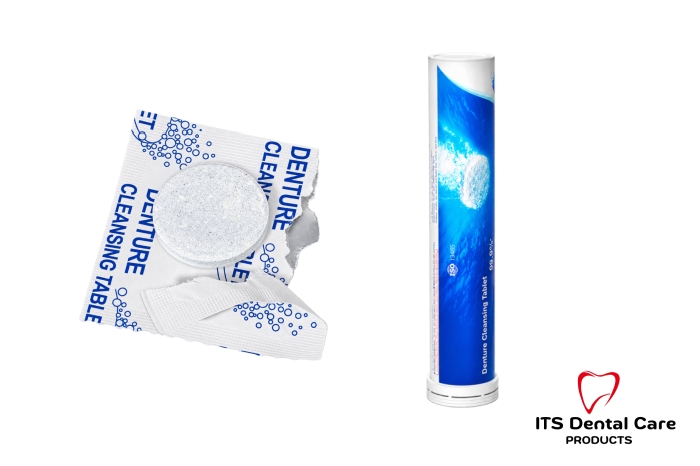
Packaging for denture cleaning tablets is part of the product’s protection system, not only its appearance. Effervescent tablets react with moisture, so the pack must help preserve physical integrity and performance through manufacturing, shipping, storage, retail, and daily consumer use.
The two common routes—individually sealed foil sachets and multi-tablet tubes—solve that problem differently. The best option depends on humidity exposure, pack count, consumer routine, branding, production equipment, order quantity, distribution channel, and the evidence available for the complete product-pack combination.
The Short Answer
Choose foil sachets when individual protection, travel convenience, dose visibility, and resistance to repeated pack opening are priorities. Choose tubes when compact presentation, quick daily access, reduced secondary-pack volume, and a reusable container experience matter more. For either format, verify the actual barrier structure, seals or closure, desiccant strategy, line capability, MOQ, and stability or transport evidence—do not decide by appearance alone.
Side-by-Side Packaging Comparison
| Decision factor | Individual foil sachets | Multi-tablet tubes |
|---|---|---|
| Moisture exposure after opening | Each unopened tablet remains separately sealed | All remaining tablets share the opened container |
| Consumer use | Tear one dose; convenient for travel | Open, remove tablet, and reclose |
| Pack count flexibility | Easy to configure different counts in cartons | Limited by tube dimensions and fill count |
| Branding area | Foil plus retail carton | Printed/labelled tube plus optional carton |
| Production inputs | Foil structure, printing, sealing, carton | Tube, closure, liner/desiccant, label or print |
| MOQ driver | Printed foil and carton runs | Custom tube components, color, label/print |
| Shipping cube | Flat packs can pack efficiently | Rigid tube may use more volume but resist crushing |
Why Moisture Protection Comes First
Denture cleaning tablets are effervescent. Unwanted humidity can contribute to softening, swelling, cracking, surface reaction, odor changes, sticking, slower or uneven dissolution, and reduced shelf-life confidence. Packaging selection must therefore be connected to storage conditions, distribution climate, tablet formulation, and shelf-life requirements.
ITS Dental Care’s denture cleaning tablet page lists foil pack as its standard packaging route and advises cool, dry storage. A buyer considering a tube should ask for the exact available configuration and supporting evidence rather than assuming any generic tube provides equivalent protection.

How Foil Sachets Protect the Product
Foil sachets isolate tablets individually. When a consumer opens one dose, the remaining tablets stay sealed. This is useful in humid bathrooms, travel packs, care facilities, clinics, and markets where a retail pack may remain open for months.
Advantages of foil sachets
- Individual moisture protection until the moment of use.
- Clear unit-dose handling and easy counting.
- Flexible retail counts using the same tablet and sachet dimensions.
- Convenient sample, travel, subscription, and institutional formats.
- Large printable surface when branded foil is commercially feasible.
Trade-offs to verify
- Printed foil may create a higher component MOQ and setup charge.
- Seal width, laminate structure, print registration, tear behavior, and coding must match the line.
- Retail cartons are commonly needed for instructions, protection, and shelf presentation.
- More individual material pieces may affect cost and sustainability goals.
How Tubes Protect the Product
A tube uses one rigid container and a repeatedly opened closure. Protection depends on tube material, wall and closure design, fit, liner or gasket, desiccant arrangement, headspace, filling conditions, and how quickly the consumer recloses it. The complete system—not the word “tube”—determines performance.
Advantages of tubes
- Compact, recognizable presentation for daily-use tablets.
- Fast access without opening a separate sachet each time.
- Rigid container helps protect tablets from crushing.
- The tube can carry labels or direct printing and may reduce the need for a large carton.
- Potentially fewer individual packaging pieces, depending on the final configuration.
Trade-offs to verify
- Every opening exposes the shared headspace to ambient humidity.
- Closure performance and consumer reclosing behavior become critical.
- Custom colors, molded components, printing, labels, and closures can impose separate MOQs.
- Tube dimensions affect filling equipment, retail shelf space, shipping cube, and FBA fees.

MOQ and Cost: Ask Which Component Sets the Minimum
The denture cleanser MOQ guide explains that custom packaging often sets the practical order minimum. For foil, ask about unprinted versus custom printed laminate, minimum kilograms or impressions, plates or cylinders, and unused inventory. For tubes, ask about stock versus custom diameter, color, cap, desiccant, label, direct printing, tooling, and minimum component purchases.
Do not compare only cost per empty package. Compare the complete packed retail unit: tablets, primary pack, carton or label, coding, line setup, testing, master carton, pallet, freight cube, and expected waste.
Production and Quality Checks
| Control | Foil sachets | Tubes |
|---|---|---|
| Incoming components | Laminate identity, thickness/barrier evidence, print | Tube, cap, liner/desiccant, label/print |
| Line setup | Dose position, seal temperature/pressure/time | Fill count, closure application, torque/fit |
| In-process checks | Seal appearance, alignment, coding, count | Closure fit, count, label, coding |
| Integrity verification | Seal integrity or leak-related method | Closure/container integrity and desiccant condition |
| Finished pack | Carton count, sachet damage, transport test | Tube damage, cap security, transport test |
Test methods and acceptance criteria should be agreed for the actual product and pack. Buyers should request results from routine production controls and any project-specific stability, compatibility, barrier, seal, closure, or shipping work required for the destination market.
Which Format Fits Each Sales Channel?
E-commerce and subscriptions
Foil sachets support multiple counts and help protect unused tablets during long household use. Tubes can create a compact branded object, but dimensions and fulfillment fees should be modelled before approval.
Pharmacy and retail shelves
Both formats can work. Carton dimensions, shelf blocking, tamper evidence, directions, barcode visibility, and local consumer expectations may determine the stronger option.
Dental clinics, care facilities, and sampling
Individually sealed doses can simplify distribution and reduce exposure of remaining tablets. If tubes are used, handling instructions and closure discipline become more important.
Travel and hospitality
Small sachet counts are easy to distribute and pack. A tube is convenient for repeated use but occupies a fixed volume regardless of remaining tablet count.
A Practical Decision Scorecard
| Question | Favor foil when… | Favor tubes when… |
|---|---|---|
| Humidity risk | Repeated opening is a concern | Closure system is validated for use conditions |
| User routine | Single doses and portability matter | Fast daily access matters |
| SKU plan | Several pack counts are needed | One stable count and size are planned |
| Brand strategy | Carton and foil graphics lead | Container presence leads |
| MOQ | Stock/printed foil route fits volume | Stock/custom tube route fits volume |
| Logistics | Flat packing is advantageous | Rigid protection outweighs cube |
Questions to Ask Before Approving Packaging
- What exact material structure, supplier, and component specification are quoted?
- What are the MOQ and lead time for every foil, tube, cap, desiccant, label, and carton version?
- Which setup, tooling, plate, cylinder, proof, and testing charges are one-time?
- What seal or closure controls are performed during production?
- What shelf-life, stability, compatibility, and transport evidence applies to this exact configuration?
- How are lot and expiry codes applied and verified?
- What are retail and master-carton dimensions, gross weight, and pallet configuration?
- Who owns and stores unused printed packaging, and what happens after an artwork change?
Final Takeaway
Foil sachets are usually the stronger default when individual moisture protection and pack-count flexibility lead the brief. Tubes can be the better commercial format when daily convenience, rigid protection, and container branding are central—and when the complete closure and desiccant system is verified.
Review available private label denture cleaning tablet specifications, understand how packaging affects MOQ, and request samples and a packaging-specific quotation before freezing artwork.


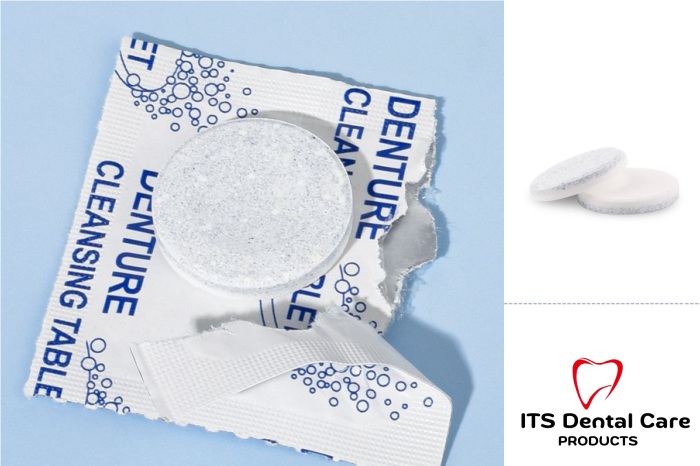


ITS Dental is a trusted manufacturer of high-quality denture care products, including denture cleaning tablets, adhesive creams, and retainer cleaning solutions, offering customized services for global partners.