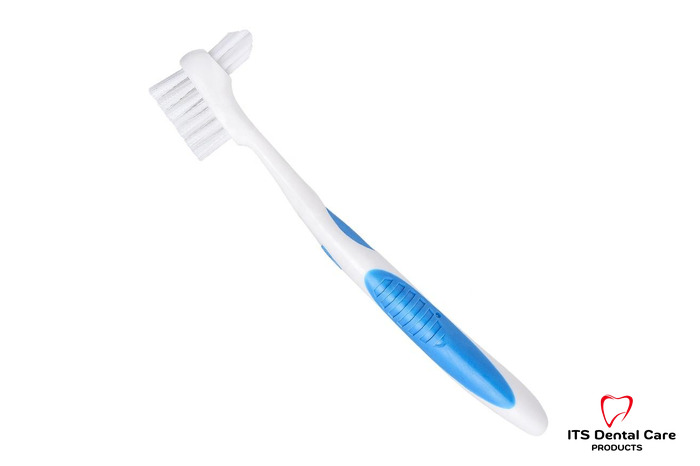
A denture brush is easy to recognize in a photograph and difficult to approve from one. Two brushes can share a dual-head outline yet differ in filament feel, tuft security, head access, handle grip and retail presentation. For a private-label order, those differences belong in a written specification linked to a physical reference sample. Otherwise, a buyer may approve an attractive picture while the supplier and receiving team work from different versions of the product.
This guide is for dental distributors, oral-care brands and product managers comparing denture-brush samples. It describes what to ask for and how to record a decision; it does not assign unverified material grades, dimensions, certifications or performance results to an ITS Dental brush. Our denture brush product page shows the current product family. Confirm the details of the model you intend to buy in its own approved drawing and order documents.
What should a denture brush specification identify?
Start with a model code, revision and intended user. Name the large and detail heads separately, even if they are molded on one handle. Record the intended denture types, head geometry, filament description, handle construction, color reference, logo position and consumer pack. Ask which features are already available and which would require a different component or tool. “Ergonomic dual head” is a useful description for a catalog, but it cannot tell a supplier what to make or an inspector what to accept.
Use one version of the specification for the sample, quotation, artwork and purchase order. If a blue grip and a second colorway will be separate retail SKUs, give each a distinct code and approved color reference. Do not assume that a packaging drawing or a photograph settles the filament material, head size or grip compound. Those fields need their own source documents and agreed acceptance checks.
| Part of the brush | Field to specify | Evidence to retain |
|---|---|---|
| Large head | Shape, working area, tuft layout and trim | Drawing plus an approved physical sample |
| Detail head | Angle, reach and clearance for the intended appliance | Drawing and a handling trial |
| Filaments | Material, supplier grade, diameter, trim and stated stiffness | Material declaration and sample comparison method |
| Tuft attachment | Visible looseness, gaps and retention check | Agreed test method and defect examples |
| Handle | Material, dimensions, grip texture and color | Component drawing and wet-handling sample |
| Branding and pack | Mark location, artwork revision, pack count and lot identification | Print proof, packed sample and carton specification |
The list is a request for controlled fields, not a claim that every value is currently available for every model. Put an owner beside each open field. A buyer can then decide whether a missing value must be resolved before a sample is signed or whether the quotation can proceed with a clearly stated assumption.
How should bristles be assessed without relying on “soft” alone?
The word “soft” describes a user impression, not a complete procurement specification. Ask for the filament material and grade, diameter or other relevant construction reference, trim length, tuft pattern and the method used to compare stiffness. If the supplier proposes a change, request a new sample rather than assuming that two materials with the same marketing label will feel or wear alike. Record both the requested reference and the supplier’s proposed value; do not fill an unknown number from another brush listing.
The American Dental Association’s partial-denture care guidance advises a brush shaped for dentures or a soft-bristled toothbrush and warns against hard bristles that may damage a denture. That guidance explains why a buyer should review the intended brush and denture materials together. It does not certify a particular filament, prove that a sample is non-abrasive on every appliance, or set a universal filament diameter. If compatibility is central to a claim, agree a product-specific assessment with a suitable professional before putting that claim on the retail pack.
Compare samples under the same conditions. Use the same reference denture or representative material, the same wetting and cleaning method, and the same observer notes for each candidate. Record how the filaments reach broad surfaces and narrow areas, whether tufts shed or splay during the agreed trial, and whether the head has sharp or poorly finished edges. A visual trial is useful for choosing a sample; it is not a microbiological, abrasion or long-term durability test.
What should buyers check about a dual-head design?
The large head and the smaller angled head have different jobs. A broad head should reach the surfaces the product is intended to clean without forcing the user into an awkward grip. The detail head should reach the recesses named in the brief without pressing against delicate attachments. Ask a dental professional or experienced user to try the intended motions on representative appliances, then record where each head reaches and where it does not. Avoid promising access to every clasp or denture design from one photograph.
Check the physical sample against the drawing: head width, angle, tuft placement, transition to the neck and finished edges. Measure the sample consistently, then confirm whether the drawing refers to the whole brush, the head or a component. A small change to an angled head can affect reach even when the handle and retail photograph look unchanged. Keep the selected physical sample available for comparison with a later production sample.

This published product image shows dimensions for one existing model. It is an illustration, not the approved drawing or a dimensional promise for every private-label order. Confirm the final model and tolerances in the signed SKU specification.
What makes a handle and brand mark ready for approval?
Confirm the handle length and shape for the selected model, grip position, surface texture, color reference and intended logo area. Handle comfort should be judged with the finished sample, including when wet; an enlarged rendering cannot show how a molded grip feels. Ask whether the grip is part of the handle, a separate component or a surface treatment. Each construction calls for a different material and color reference in the specification.
Decide whether your brand belongs on the handle, the retail pack or both. For a handle mark, record the proposed method, position, size, color and orientation. Ask for a physical proof on the chosen surface before approving it. A mark that reads clearly on a flat PDF may be distorted by a curved or textured grip. Keep the logo file revision and the accepted marked sample together, and state who may approve a different print method.
Retail presentation is a separate approval. Record the pack material and size, brush orientation, any insert, label copy, barcode and lot-identification location. If the same brush will be sold in a pharmacy blister and a clinic bulk pack, treat those as distinct pack configurations with separate artwork and counts. The packaging artwork approval checklist addresses copy and proof sign-off; the brush specification must still identify the physical brush and the pack used for the order.

This is an existing retail-pack example, not an approved private-label design for your market. Final artwork, barcode, language and pack construction require project-specific review.
What should sample approval and incoming checks cover?
Keep a signed product sample and a separately approved packed sample. Record the brush model and revision, sample date, head geometry, declared materials, color, mark and pack version. Note any visible defect that would put the sample on hold: loose or uneven tufts, sharp edges, surface marks, poor color match, a misplaced logo, an incorrect brush count or a damaged pack. Agree how a production sample will be compared with the reference before releasing a bulk order.
Separate a design decision from a lot decision. A well-made sample shows that a proposed design can be evaluated; it does not set the sampling plan or acceptance limits for every shipment. Ask the supplier and your quality team to define the inspection method, sample quantity, defect categories and response to a failed check for the actual order. Do not import an AQL level or pull-force limit from a generic article. The pre-shipment inspection guide explains buyer-side sampling questions for tablets, but a brush order needs its own agreed defect list and acceptance method.
| Approval stage | Question to answer | Record to keep |
|---|---|---|
| Unmarked product sample | Are the head, filaments and grip acceptable for the intended design? | Model code, drawing revision, sample photos and reviewer notes |
| Branded sample | Is the mark correct on the finished handle or pack? | Artwork revision and physical print proof |
| Packed sample | Does the correct brush and quantity sit in the approved pack? | Pack reference, label proof and sealed sample |
| Production or incoming check | Does the delivered lot match the accepted references? | Agreed method, findings, lot ID and disposition |
Record the decision as approved, approved with named open actions, or revision required. A buyer who accepts the brush but has not approved the blister artwork should say so explicitly. If a filament supplier, tufting method, mold, grip material or logo process changes, identify which sample and test need to be reopened. A quiet material substitution should not inherit the approval of an earlier physical sample.
What should go into a private-label brush RFQ?
Send the intended sales channel, destination market, model reference or required head shape, filament and handle questions, branding method, retail-pack format, first-order estimate and forecast. Mark missing material grades, dimensions or tests as supplier to confirm. Ask the supplier to separate existing-model options from changes that require tooling, print setup or a new sample. Keep the quotation, product specification and artwork revision aligned so a later price comparison refers to the same brush.
Request the documents your buyer or destination market needs for the selected SKU. Material declarations, product samples, packaging proofs and inspection records serve different purposes; one should not be represented as another. If a supplier states a certification, durability result, material safety property or lead time, ask which current document and product configuration support it before reusing that statement in your own listing.
Send us the intended brush model, sales market and pack questions through the ITS Dental contact page. We can discuss the current product options and the points that need a sample or written confirmation before you place a private-label order.



ITS Dental makes denture-care products and discusses product and packaging requirements with B2B buyers.